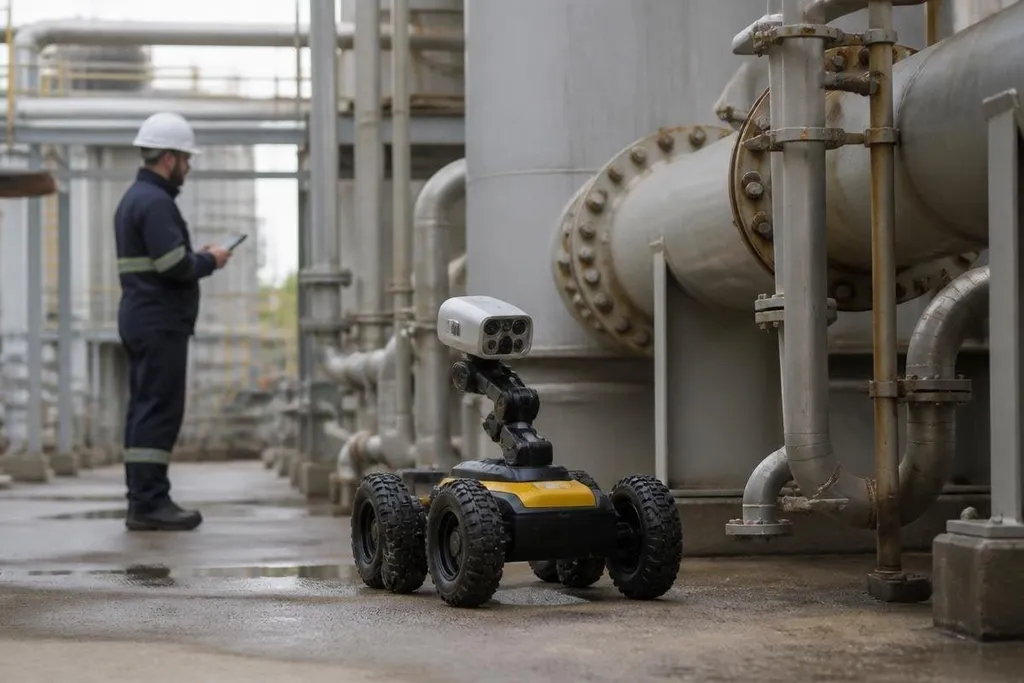
Energy robots will first take on work that is dirty, dangerous, or spread across large sites. The useful question for an energy operator is where a robot can repeat one task safely, with less downtime and clear human control.
- Inspection robots can carry cameras, thermal sensors, or gas sensors.
- Remote operation still matters when a robot meets a damaged pipe or blocked route.
- The hard test is repeatable work outside a controlled demonstration.
Inspection comes before repair
Inspection units can move through a power station, pipeline route, mine, or solar field while collecting images and sensor readings. That data can help a technician find heat, leaks, corrosion, loose parts, or damage before sending people into the area.
The robot does not need to fix the problem to save work. A clear image from a difficult location can help a team decide whether to shut down equipment, send a person, or schedule a repair during planned maintenance.
This makes inspection a practical first step. The task has a clear start and finish, and a human can check the result against the robot's report.
Energy sites are hard places for machines
Outdoor sites bring dust, rain, glare, uneven ground, and weak communications. Indoor plants add stairs, narrow routes, pipes, cables, heat, and equipment that may change position during maintenance.
A mobile robot needs sensors to map its route and avoid obstacles. A drone needs a safe flight area, enough battery time, and a plan for signal loss. An arm needs a fixed work area and a clear way to stop its motors.
Those limits shape the market. A platform designed for a flat solar field may struggle inside a power plant. A platform that works well with remote control may need a different design before it can act on its own.
Humans will stay in the control loop
Autonomous systems can handle repeated movement and sensor checks, but energy work includes unusual faults. A fallen tool, a damaged guard, or a blocked passage can change the task in seconds.
Remote operation gives a technician a way to step in. The robot can send video and sensor data while the person makes the call. This approach also gives teams a record of what the robot saw and when it saw it.
For energy teams tracking these handoffs, reports at Robot24.com can place the robot model, test site, date, and measured result beside each company claim before a deployment is planned.
The next stage will depend on clear handoffs. The robot should report its location, battery state, sensor readings, and reason for stopping in words a technician can act on.
Repairs need better proof
Inspection can produce useful data without touching the equipment. Repair asks more from a robot because the machine must apply force, place a part correctly, and recover when the job changes.
For repair work, the machine may need a gripper, torque control, depth cameras, and a safe stop system. Each part adds another point to test. A task that looks easy in a video may depend on a clean surface, a fixed camera angle, or a person nearby.
I’d put money into inspection and remote support before fully independent repair. Those jobs give operators a clearer way to measure results, and they leave a trained person in charge when conditions change.
A buying test for the next project
Use this checklist before you approve an energy robotics pilot:
- Name the task: Write down the exact job, location, start condition, and finish condition.
- Set the human handoff: Decide who takes control when the robot stops or loses its signal.
- Check the site: Record ground type, stairs, heat, dust, rain, lighting, and communication coverage.
- Measure the result: Pick a number such as inspection time, missed faults, or hours spent in a restricted area.
- Plan the data: Decide where images and sensor readings go, who checks them, and how long they stay available.
- Price the full job: Include operators, charging, repairs, training, software, site changes, and downtime.
The next useful energy robot will probably have a narrow job and a clear record of its work. When an operator can compare that record with the cost and risk of sending a person, the robot has a fair test.